
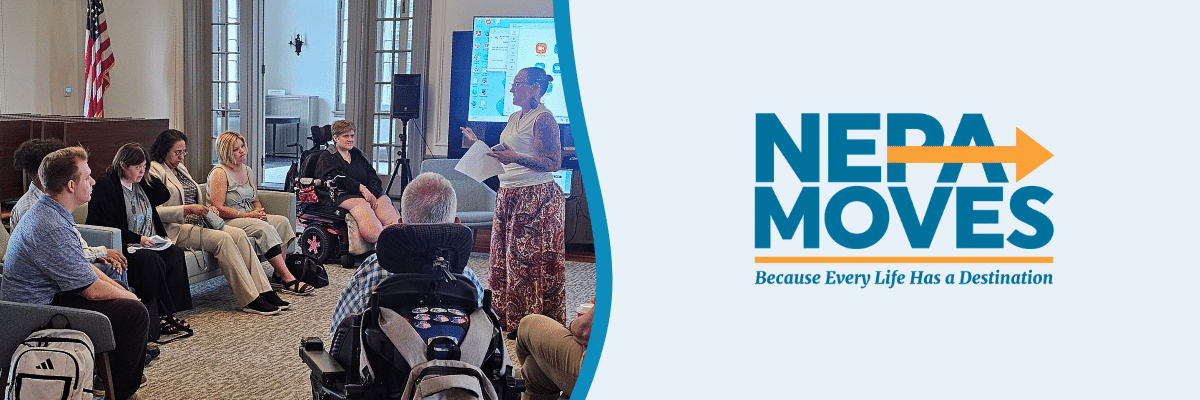
Stories and perspectives from the people who rely on public transportation in Northeastern Pennsylvania.
Some community conversations deserve to continue long after the meeting ends.
At a recent NEPA Moves gathering, the Scranton Area Community Foundation brought together people who regularly use public transportation in Lackawanna and Luzerne counties to talk about what transportation looks like in their everyday lives.
At the Foundation, we know that strong communities depend on people having access to what they need to live, work, learn, and connect. Transportation plays an important role in making that possible. And part of our role is listening to the people who experience our community’s opportunities and its barriers every day.
The conversation also included information from Transit for All PA about Week Without Driving PA, a statewide initiative taking place October 1–8. To learn more and explore how you can participate in WWD PA, visit weekwithoutdrivingpa.org.
But what we heard that morning was about much more than buses and schedules.
It was about time, work, healthcare, independence, connection, and the ability to participate fully in community life.
The stories shared with us stayed with us. We think they’re worth sharing with our community, too.
Explore the Stories
The experiences shared that morning showed how transportation touches nearly every part of daily life. Explore four stories about what transportation access can make possible, and what becomes harder when getting there isn’t simple.
The Hidden Time Cost of Transportation
When a trip takes more than a trip.
One participant traveling from Wilkes-Barre to Scranton caught a bus at 5:55 a.m. to attend our 9:00 a.m. conversation.
For people who don’t drive, getting somewhere can begin hours before the trip itself.
When Transportation Becomes a Workforce Barrier
A job isn’t an opportunity if you can’t get there.
Training, job opportunities, and willing workers are only part of the workforce equation. People also need a realistic and reliable way to get to work—and back home again.
When Transportation Becomes a Health Barrier
Getting care still requires getting there.
One participant described a trip to a dental appointment that involved nearly three hours of travel. Ultimately, the appointment had to be canceled.
Healthcare access doesn’t begin when someone walks through the doctor’s office door. It begins with whether they can realistically get there.
Public Transportation Gives Us More Than a Ride
Independence shouldn’t require a car.
Participants talked about transportation as more than a way to reach a destination. They talked about work, relationships, independence, connection, confidence, and the ability to participate in community life.
Thank You to Our Participants
Thank you to the transit riders who joined us and generously shared their experiences. Their perspectives are at the heart of this series and are helping our community better understand what transportation access looks like in everyday life.